|
|
Thinking for a change
Marc Evers and I hosted a “Thinking for a Change” session. Not the whole session, just the “Current Reality Tree” to discover root causes of problems participants brought to the session.
Team 1: the build keeps failing
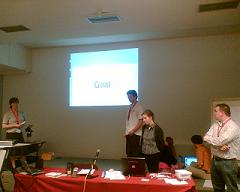
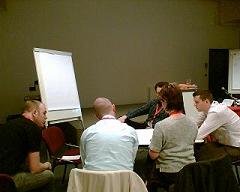
On the left, the first group. They analyzed a problem where a team had a failing build for days on end and didn’t do anything about it.
You have to wonder why they put the automated build and tests in place. What was their goal?
Team 2: balance between work and life
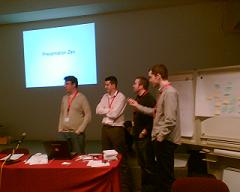
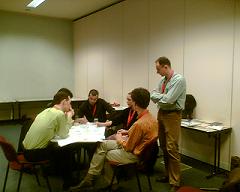
The second team, on the right analyzed the root causes of a situation where the balance between work and life wasn’t right. This was due, amongst other things, to long travel times between home and workplace. We had a similar situation during the session at SPA 2006.
You can use the thinking tools for other things than technical problems.

Team 3: getting two teams to work together
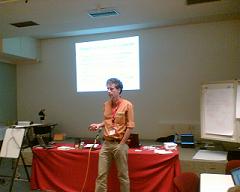
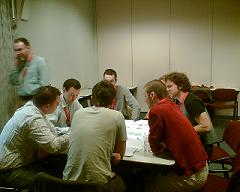
The third team analyzed a situation where development and operations teams didn’t work well together.
This situation was quite similar to the one I present to explain the technique, except that my example talks about one team and this situation was about the whole company. I managed to resolve the problem for one team. It will take a bit more thinking and effort to solve it for the whole company.
Finding the root of all evil
The teams found some potential root causes for their problem, but they needed a bit more time than the 90 minutes we spent today. I hope the three “customers” got a bit more insight in their situation. I find the Current Reality Tree a very useful tool to concentrate on a problem. All too often, we jump directly to a solution, before we really understand the problem. The CRT steps force me to go slowly and study the problem in depth, before I can start to think about solutions, with the Future Reality Tree.
I use the Thinking Processes every day, together with the other people who are involved in the situation. I don’t need to explain the technique, we just do it. All it takes is a piece of paper, a pen and a few people who want to solve a problem.
Agile Open today! When we organize an event, I always feel like I did when exams started: after all that preparation, it’s finally started. No more stress, just do it!
Planning a conference
First thing in the morning, everyone briefly presents the session ideas they put on the conference site. Some sessions got invented on the spot. Usually, these are of the type “I have a problem with X. Who can help me solve this problem?”.
After that, everybody votes for their favourite session by putting stickers on the session descriptions. Then, it’s a simple matter of scheduling the sessions in 6 slots in 2 tracks, taking into account the constraints:
- A session leader can’t do two sessions at the same time
- We have one large room and one smaller room.
- We have one beamer.
We made a definite schedule for today and a tentative one for tomorrow. Tomorrow we’ll revisit the schedule and may reschedule, based on the new information we’ve gained.

We will organize the second Agile Open conference on 27 and 28 April 2006 in Mechelen, Belgium.
Early registration for Agile Open 2006 ended on Friday. As usual when you set deadlines, a lot of registrations came in on the last day. Student Syndrome at work. Or is it the “Decide at the latest responsible moment” Lean principle at work?
We’ve now got 24 early registrations, that’s as many as the total number of participants last year. For the organizers, that means we’re in the “good scenario”.
Before every event, like the XP Days Benelux, we perform “scenario planning”. We explore different alternatives and decide what we would do in each scenario. We always have at least 3 different scenarios: “bad” , “normal” and “good”. As time goes by, we compare reality with our scenarios and see which one fits best. Of course, we adapt as new information emerges. We also keep a risk list, so that we know how to react when something bad happens. Both of these practices help us to organize an event without too much stress.
Why not try some scenario planning on your next project? Try to imagine a scenario where everything goes wrong; picture another scenario where everything goes well. How will you react when the different events happen? A scenario is not a prediction, a scenario helps you to recognize important events early and to be ready to react appropriately. Of course, you keep updating your scenarios and risk list as you get more information.
If you want to attend Agile Open, don’t wait too long to register, as there are only 16 places left.
p.s. What’s that “A princess arrives…” risk about? During the second XP Day, we heard the day before the conference that a Belgian princess would attend another event in the same location. Due to security reasons, we couldn’t have one of the rooms we had booked. Unfortunately, the replacement room we were offered, was quite far away from the other rooms. In the end things got resolved and we got all the rooms we had booked.Lesson learned: even if you do risk analysis beforehand, stuff will happen. From now on, the Princess is always on our risk list: both Belgium and The Netherlands have princesses. The Princess risk stands for any event where we can’t get the rooms we booked. We’re prepared for that. What new bad stuff will happen this year? Stay tuned…
Tags: agile, Agile Open, Open Space

We will organize the second Agile Open conference on 27 and 28 April 2006 in Mechelen, Belgium.
Agile Open is an open space conference about Agile topics. The idea is simple:
- participants can submit ideas for sessions
- at the start fo each day, we perform a quick planning game to select the sessions that will run in the two tracks
To get an idea of the range of session, take a look at the output of last year’s sessions.
Registration is now open! Don’t wait too long to register, as there are only 40 places.
Tags: agile, Agile Open, Open Space

At the XP.BE user group meeting hosted by ERG Transit Systems, we ran a workshop on “Management metrics”.
The people at ERG wanted to introduce some metrics to get feedback on their process improvement efforts. However, metrics can be dangerous. “You get what you measure”, but what you measure may not be what you intended.
We used a workshop format designed by Jason Gorman and Duncan Pierce to design, break and improve metrics. The session went like this:
- we formed 4 teams
- 3 people from ERG presented 4 requirements for metrics, one for each team. For the rest of the session, they acted as “onsite customer”
- each team designed and presented a metric to satisfy the requirement
- each team received another team’s metric and tried to “game it”, to subvert it to reach the opposite of the desired effect, or to score as high as possible with the least amount of effort. This was the fun part.
- each team then improved their metric, taking into account the possible “misuse”
- our customers performed the acceptance test. Each metric had to pass two tests:
- Would our customers be able and willing to implement this metric tomorrow?
- Would the developers want to work in a team that used this metric?
3 out of the 4 metrics passed the user acceptance tests. The fourth might too, with a bit of work. Not bad for 90 minutes of work!
Some things I learned about metrics:
- No metric is fraud or misuse-proof, therefore people have to want to use the metric correctly. If people want to game the system, they can be very creative.
- Metrics that take a noticeable amount of time and work to collect will not last long
- It’s better to aggregate data, because errors in the individual items tend to cancel each other out. E.g. it’s easier to track the estimates of a whole release, rather than the estimates of each individual feature
- It’s better to look at team results, rather than individuals, because of the aggregating and because that motivates people to work as a team. This is related to the “Reward one level up” rule I first heard from Mary Poppendieck.
I ‘d like to align metrics with the “Throughput Accounting” measures. I’ve added an “Idea for Session” about this topic on the Agile Open site. How about you?
More useful info and books on the wiki.
Jason and Duncan will host this session at SPA2006. Highly recommended!
Update 20/02/2006 Nico Mommaerts has blogged about this event too.
Tags: SPA 2006, Agile Open 2006, metrics, XP
|
|