Aug
29

Agile 2010 session materials online

I co-presented three sessions at Agile 2010. The materials for these sessions are now available:

I hope you enjoyed the session or get some useful ideas from the session materials. Let us know how you’ve applied these tools.

Jun
09

Lean & Kanban Europe 2010

I’ll present “Lean out your product backlog with lean product development and business analysis techniques” at the Lean & Kanban Europe 2010 conference.

The session will show how using business analysis and kanban techniques we can create a flow from business goals to implementable user stories with acceptance test, focus on value-delivering capabilities and involve the whole team in product development.


Lean & Kanban 2010 Europe Speaker

Jun
08

Université du SI 2010

I’ll co-present a session with Christophe Thibaut about the “A3 process” at the Université du SI conference on July 1-2 in Paris.

The “A3 report” is a standardized report format used within Toyota and other companies to make proposals and report. The standardized and constrained format helps the writer and readers to come to the point quickly, concentrate on the essentials and get the important information without wasting time.

However, when applying this technique we often only implement the superficial elements, the fact that the documents are limited in size and have a standardized format. Sometimes, the exact format of the Toyota reports is copied. And then we’re disappointed because this “cargo cult” application only delivers limited benefits.

In this session we’ll look at and let participants experiment with the social aspects of the A3 report:

  • How we define the standardized format to support our goals
  • How leaders and managers use A3 report writing by their team members are structured one-to-one coaching
  • How to build in iteration and feedback from peers to improve the proposals
  • How to use the review process as a consensus building tool
  • How to present reports in such a way that they’re heard, understood and accepted

Come and play with us if you want to learn more about this powerful continuous improvement and learning tool.

If you want to know more…

Jan
29

Value in Lean

In search of Lean Business Value

I’m looking for useful and usable definitions of Business Value. Lean should have a lot to say about value (when they’re not talking about waste): Value Stream, (non-)value-adding work, Value Stream Manager.

And yet, a book like Creating a Lean Culture: Tools to Sustain Lean Conversions that describes Lean Management doesn’t define what Value is or how you define it. The Lean Manager’s job is to ensure that the right thing is done the right way. “The Right Thing” has been defined beforehand and the Lean Production Manager ensures that the value (as defined in the product to deliver) is delivered quickly and efficiently. In production, quality has been defined and is constant (except when the product changes). The emphasis of the production manager is on “the right way” and increasing flow by reducing waste because those are the only variables the production manager (and workers) can influence.

Implementing Lean Software Development: From Concept to Cash has a separate chapter on Value, which comes just before the chapter on Waste. The chapter doesn’t really define value. The closest to a definition of value comes from Lean Solutions: How Companies and Customers Can Create Value and Wealth Together. What do customers want?

  • Solve my problem completely
  • Don’t waste my time
  • Provide exactly what I want
  • Deliver value exactly where I want it
  • Supply value exactly when I want it
  • Reduce the number of decisions I must make to solve my problems

This gives us a good set of criteria to check, because each of these criteria reduces the customer’s value if done badly. How do we know what customers value? The advice is to understand the customer by:

  • Living in the circumstances of the customer, for example when the chief engineer of the Siena minivan cruises from Canada to Mexico to understand how to improve the car.
  • A similar technique is “apprenticing”, where we learn how to do the work from a user
  • Observe real users at work
  • Perform usability testing to ensure we haven’t reduced customer value

Toyota Way Value

If we look at the 14 Management Principles from the World’s Greatest Manufacturer from the Toyota Way (p. 37) we see that Customer and Value are only mentioned a few times:

  • Generate value for the customer, society and the economy – Principle 1: Long Term Philosophy
  • Quality for the customer drives your value proposition – Principle 5: Build a Culture of stopping to fix problems, to get quality right the first time

So, Value == Quality for the Customer.

Chapter 5 describes how Quality for the Customer was defined for the Lexus.

  • Look at who the competitors are
  • For each competitor, what do customers like and dislike about them?
  • Rank order the quality attributes
  • Select a small number of target qualities (in this case: top speed, fuel consumption, noise, aerodynamics and weight)
  • Define constraints and basic needs (reliability, safety, resale value, interior…)
  • Set targets for each of the quality attributes

Now, we know that if we ask potential customers and users what they like in existing products and want to see in the new product we’re not going to get a very exciting list. In “Kano model” terms, we’re going to get the “must have” basic needs and some performance needs (“It uses a bit less fuel than my current car? Nice.”). Where do we get the exciter features that make the difference?

In this case the exciter was the word AND. The new car had to beat its rivals in all of the target qualities: lighter AND faster AND more fuel-efficient AND quieter AND… than the leader in each quality.

Toyota Production System Value

The Toyota Production System (and all the material derived from it) doesn’t say much about value because value has already been defined and is a constant (or constraint) for production. The Toyota Product Development System has as its first principle “Establish Customer-Defined Value to Separate Value-Added from Waste“.

How is this done?

  • Appoint program leaders who have the background and experience to establish an emotional connection with the target customer
  • Perform Genchi Genbutsu (Go See the Actual Work) to see the customer in action in their environment
  • Create a vision for the product which includes quantitative and qualitative goals (using “Value Targeting Process”, as described above)
  • Create a concept paper based on thorough discussion, information gathering and consensus-building
  • The leader and the concept paper guide development throughout the project
  • The project is broken down into functional teams, each with their own leader who applies the same process recursively, so that each team has a customer perspective
  • Value targets are set
  • Cross-functional teams work together to find ways to achieve all the value targets

Business Value is a Model

At Agile 2008, Chris Matts and Andy Pols had a session about Business Analysis. They made one statement which clarified what I was looking for and what I was doing:

Business Value is not a value. Business Value is a model.

There’s not just one value or one quality: different stakeholders all value lots of (conflicting) things. Moreover, value is not static. For example: whether I deliver a car (or a software project) next week or in six months can have enormous effects on your valuation of that exact same product.

As with all models, much of the value comes from the thinking about value and the modeling, not the final model. When I come onto a project, I will always ask about the Business Value Model. If you have an explicit and agreed model, decision-making will be much more effective. If you don’t have an explicit model, that tells me a lot: we’re going to have constant discussion about goals and value. Even worse, some teams have an explicit model (“espoused theory“), but use another model (“theory in use“) which leads to no end of conflicts and dysfunctional behaviour. I can usually deduce very quickly what the real model is from the actions of those involved. That’s why I like to add a third part to the statement:

Business Value is not a value. Business Value is a model. Business Value models what you value.

So… How can build a Business Value Model in our work?

Oct
30

Resolve a Conflict in 6 easy and 1 difficult step

Tried Out

CRD # 1 at Scan Agile 2009When presenters propose sessions for XP Days Benelux, we always recommend they try out their session, as many times as possible. We should all know the power of iteration and feedback. You need some time to get it right. If you’re slow like me, you might need years to get it right.

The first tryout of the “Solve Conflicts without Compromise” session was run as a “Birds of a Feather” session several years ago at the SPA conference. The session (and the technique) worked, but only barely. Then, two breakthroughs happened at the same time:

Suddenly, the technique became a lot clearer. Bill Dettmer’s explanation is very clear and practical; the session at Agile 2008 showed that it worked and could be fun.

Solve Conflicts without Compromise

CRD # 2 at Scan Agile 2009So, after a few more iterations, an updated session was created. It’s now been run twice:

  • At  Agile Tour Besançon, in French. The participants gave a lot of useful feedback at the retrospective.
  • At the Scandinavian Agile open space, in English. The pictures show the three groups analysing a conflict for their “customers”. There was no time for a retrospective, because the conference was closing. I hope the three clients will blog or email me about their experience.

The next two runs will be at the Belgium Agile/XP User Group meeting on November 5th 2009 and at the XP Days Benelux conference on November 24th.

So, what are the 7 steps?

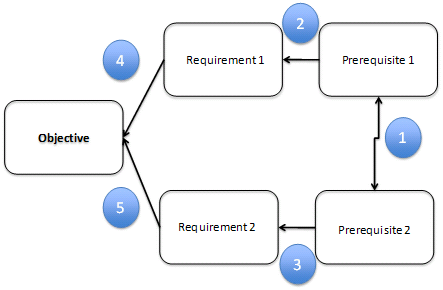
  1. Create a blank Conflict Resolution Diagram (CRD) like in the image below. 5 boxes connected with arrows. Easy.
  2. Articulate the conflict. State the problem in one of two forms, both impossible choices between conflicting prerequisites:
    • One chain of reasoning says “DO THIS”; another chain of reasoning says “DON’T DO THIS”. Now I have to choose: DO THIS OR DON’T DO THIS? I can’t have both.
    • I need two things, A and B, but they’re mutually exclusive. Now I have to choose: HAVE A OR HAVE B? I can’t have both.
  3. CRD # 3 at Scan Agile 2009Determine the goal and requirements on each side? Why do we need those two conflicting things? Because of two requirements. Why do we need those two requirements? Because we need them to reach a common goal.
  4. Evaluate the reasoning. Throughout the whole exercise we must ensure we maintain clarity: is each step in the reasoning crystal clear and well-understood by everyone? Is the reasoning clear?
  5. Develop underlying assumptions. If the CRD says “To achieve X we need Y”, ask “Why do we need Y to achieve X?”. All the answers are the underlying assumptions of the reasoning. Use “extreme wording” to make the assumptions stand out and almost beg to be invalidated. For example: “Why do we need to introduce Test Driven Development to achieve better quality?” Because…
    1. TDD is the only way to improve quality
    2. TDD is the most fun way to develop software
    3. TDD catches all errors
  6. Evaluate the assumptions. Which assumptions are valid? Which assumptions are invalid? Which assumptions could be challenged. If there are no valid assumptions behind a step in the reasoning, the reasoning is invalid. At this point, the whole conflict may have “evaporated”.
  7. Hard: Create injections. This is the creative bit where we find ideas to invalidate those assumptions that hold us back from creating a win-win situation, one where we achieve our goal in a way that satisfies everyone involved.

Solve conflicts-lWhy is this difficult?

When I see the participants in action, there are some difficulties that appear every time:

  • It’s hard to maintain the consultant’s stance and only ask questions. That’s why we have strict rules about what the consultants can do: they can only ask a limited set of questions.
  • We want to jump to the solution immediately without taking the time to understand the real problem. That’s why the session doesn’t allow talking about solutions, only about problems.
  • We censor our assumptions. Instead of brainstorming all our assumptions, we only talk about those that seem reasonable. That’s why there’s a lot of pressure in the session: you have to come up with at least 25 assumptions in 5 minutes. That’s just not possible if you think about the assumptions.
  • The most interesting assumptions are those that we no longer think about, the things that are “common sense”. That’s why we have people external to the problem questioning the client and why we bring in some “fresh blood” with a fresh perspective halfway through the session.
  • It hurts when we really think about a problem. It’s easier to just settle for a compromise. That’s why we can’t accept any solution where one of the involved parties is not completely satisfied with the outcome.

What’s in it for me?

  • The CRD provides a structured method to investigate a difficult conflict and channel our creativity.
  • You don’t have to settle for compromise and mediocrity. You can get what you really need.
  • It’s a lot easier to bring about changes if everyone affected benefits. As Machiavelli noted: “You will only get lukewarm support from those who will benefit from the change and strong resistance from those who stand to lose”. What if there were no losers?
  • Your projects can deliver more business value per cost if you can find the breakthrough ideas that make those painful tradeoffs (or more correctly: horse trading) between stakeholder goals unnecessary?
  • You can get more sales if your competitors offer “EITHER/OR” solutions and you can offer “AND” solutions. But first the customer has to regain hope that a solution is possible. Going through a CRD exercise with a customer and offering to invalidate all the assumptions that cause their conflict is an offer they can’t refuse.

The ChoiceWhat do I need?

  • A bit of time. Most participants got several ideas to resolve their conflict within the 90 minutes of the session.
  • Some simple materials: pen, paper and plenty of Post-Its
  • The willingness to think hard
  • The openness to share all assumptions
  • The courage to challenge every assumption, even those that are “holy” or common sense. Especially those.

It’s simple, but not easy. The question is: do you want an easy life or a meaningful life? That’s the choice you have to make.

Oh! “Easy OR meaningful”? That sounds like a conflict! Why can’t I have both?

How would you evaporate this conflict?