
Agile North

Agile North I spent a nice day at Agile North in Preston, on Sepember 20th. The Agile North group organized this one day Agile conference.

Rob Westgeest and I met at Manchester Airport with Kevin Rutherford, who drove us deftly to Preston, just before the approaching traffic jams.

The conference started with a keynote by Rachel Davies, current chair of the Agile Alliance. The talk told us how Rachel got into agile software development and her advice on moving to agile software development. Her theme was a common one among experienced agile practitioners: it’s about the values and principles. You’ll have to tailor the practices to your own situation. Start with a documented agile methodology, any methodology, the one that seems to fit your environment best. Start delivering and reflecting upon what you do. Adapt the method. And again. Use retrospectives for the reflection part (more about that later).Charles Weir
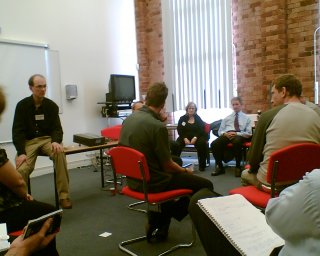
The first session was a goldfish bowl, organized by Charles Weir (on the left of the picture, seated on the table) about “Dealing with Customers”. Unlike most goldfish bowls I attended, this one was relaxed and featured some interesting discussion and tips on how to work effectively with customers. The audience had a nice mix of experienced people who could tell stories of success and failure, and people new to agile, looking for ways to improve their customer relationships.

The session was not about great ideas and breakthroughs. Most of it were small, simple ideas that everyone could apply, few of them specific to agile development. It does take sustained effort to create and maintain a great customer relationship. And again, the advice was to solve your worst problems (or bottlenecks) and to adapt to local circumstances.

I would have liked to attend the Rails session too, but you can’t be in two places at the same time…
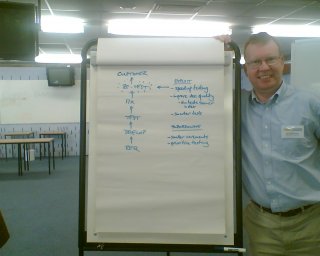
Kevin RutherfordAfter lunch, Rob and I organized the “I’m not a bottleneck! I’m a free man!” session. In this two hour session, we first introduce the “5 focusing steps” in a simulation, where the participants are asked to implement a paper boat and hat folding company. The workers got paid in chocolates.

In the second hour, some people come forward with a process that they want to optimize. The other participants act as Theory of Constraints consultants, coached by Rob, Kevin and me.

In the picture, Kevin proudly displays the result of his team: at least one way each to “exploit”, “subordinate to” and “elevate” the bottleneck of the customer. This particular system has a loop in it: software is tested and if it is defective, it is fixed and tested again. If you’re going to map this process to find bottlenecks or make a “value stream map”, it’s easiest if all the loops are unrolled and you get a linear process. How do you unroll the loop? You could take the average situation (e.g. it takes one fix-retest cycle on average); you could take a specific examples (e.g. feature XYZ went through 3 fix-retest cycles); or you can put a fork with probabilities in the diagram (e.g. 80% of all cases do not need retesting, 15% need one fix-retest, 5% need two fix-retest cycles).

The last session of the day was about agile in large organisations. I was quite interested, as I currently work for a largish organisation myself. The presenter didn’t get to finish his story, because there was a rather large amount of push-back and questioning from the audience. I didn’t get the message of the session. I’m still interested in the subject, so I’d like to see the rest of the slides.

Finally, we had a panel, where the audience could ask the “experts” questions. Rob and I had to decide which one of us would be on the panel. Rob lost, so he had to answer all the difficult questions 🙂

Agile North ended with a quick pint at the pub (kindly sponsored by Kevin) and an even quicker drive back to Manchester to catch our flight back to Belgium. All in all, a good conference, nice turnout, well-organized, interesting sessions and discussions with other participants. Thanks to the organizers for inviting us. I’ve enjoyed the conference, hope you have too!
XP Days Benelux: program announced

Finally! The program of XP Days Benelux 2006 has been published.

As usual, the program contains a mix of session on technical, management, people and other topics. A large number of sessions are interactive. There are both introductory and advanced sessions, so that people with different experience levels and interests can find something interesting in one of the four tracks.

We’ve got session presenters from Belgium (14), The Netherlands (5), The United Kingdom (4), Finland (2), France (2) and Switzerland (2). A good mix of “usual suspects” and “local talent”.

Register now, while there are still places left.

XP Days Benelux 2006

16 & 17 November 2006

Mechelen, Belgium

http://www.xpday.net

Agile North

Agile North

University of Central Lancashire, Preston.

The McCarthy Show

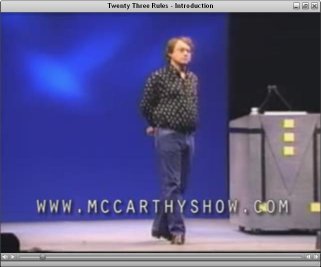
Jim McCarthy at Microsoft Jim McCarthy presenting at Microsoft

If you haven’t seen it yet, go get the videos of Jim McCarthy’s talk at Microsoft from the podcast page of the McCarthy Show. While you’re at it, why haven’t you subscribed to the McCarthy Show, the show where Jim and Michelle McCarthy talk about “Software for your Head“?

Why should you see this presentation? It’s pre-“Presentation Zen“, pre-agile, yet you’ll find many things very familiar.

The talk is about the “23 Rules” of shipping software (back in the time when at least some people within Microsoft knew how to ship…). How many slides does Jim use? 23. Or 24, because there are really 23.5 rules.

Okay, the slides still contain bullets. I’m not too fond of the yellow and white letters on blue background, in the slides. The flow of the presentation is slowed down a bit by Jim going back to the computer to advance to the next slide. He could have used a remote or someone sitting behind the computer, to keep the flow.

But those are minor quibbles. Watch how Jim delivers the talk.

He starts the talk with “This reminds me of a story about Napoleon. Napoleon, incidentally, is a big idol of Bill’s. Big surprise!”. The story is about Napoleon having only one rule for management, a good introduction to the “23 rules” talk.

The delivery reminds me of a standup comedian’s act. See for example Rule #14 “Enrapture the customer”. He illustrates the fact that “most software sucks” with a a few self-deprecating jokes and an anecdote about a woman he met on a plane. Jim goes on a rant how bad Windows, Word and Excel are that this woman has to go to college for two years to learn how to use them. Finally, he gives an example from Visual C++ to illustrate how to listen to what a customer really wants. How to make the user go “Wow!”. Great advice, great passion, great delivery.

I’m quite sure that Visual C++ AppWizard was a “Wow!” feature for those people who didn’t really understand C++ or Windows programming (or even programming in general). I remember one ex-project manager of mine actually go “Wow!” when he ran his first AppWizard-generated “Windows app”. “Hey, this Windows programming thing is pretty simple!“, he said. Needless to say that our first Windows development project had a slightly “optimistic” schedule 🙂

There are other strong points in Jim’s delivery. Watch his timing: he knows when to leave a pause, let the audience laugh, think, catch their breath. Watch how he involves the (large) audience, how he asks them questions, especially “Does this problem sound familiar?”. Watch how he modulates the intensity of his talk, sometimes joking, then ranting, telling stories and anecdotes, giving advice…

Dynamics of software developmentAt the time this talk was given, the first edition of “Dynamics of Software Development” was probably out. I had read the book, but didn’t think that I could apply most of the advice contained in the book.

Things only clicked when I read (AND understood, which took some time and re-reading) “Software For Your Head“. Jim alludes to what was to become the “Core protocols” a few times in the talk, for example when he mentions that his team is experimenting with ways to make the environment safe enough for people to express their best ideas.

The second edition of “Dynamics of Software Development” is out. Time to re-read the book and see all the things I missed first time. But first I have to read a few other books. That’s another story, for another day…

Scrum training in Belgium

Joseph PelrineJoseph Pelrine will be giving a SCRUM training course in Mechelen, Belgium on 4 and 5 October 2006.

If you want to know what SCRUM and agile are, there are few people better placed to answer all your questions… or, more likely, to raise a lot more questions, knowing Joseph :-).

Joseph practiced agile before it was called agile, a.o. working with Kent Beck on Smalltalk projects. Joseph’s involvement in Smalltalk and agile is no coincidence. Smalltalk and the smalltalk projects Kent Beck did (including C3) were a major influence on XP. With all this experience, Joseph is a master story-teller. If you not only want to know what SCRUM is, but also the why, how and the history behind it all, come to this course!

Joseph was one of the speakers at XP Day Benelux in 2003. Will he make another appearance at XP Days Benelux in 2006? Watch this space if you want to know.